
By Cathy Spalding ©
www.gentlespiritllamas.com
www.gentlespiritalpacas.com
Is there any one of us enjoying the experience of alpacas and/or llamas roaming about the area of land we call home, any one of us who has been wholly able to resist collecting their likeness in some fashion? There is so much to choose from! There are full body plush ones and porcelain ones and ones made of wood, brass, bronze, silver or glass. There are collector plates, paintings, etched wine glasses and bowls, pewter beer steins, salts, spoons and cocktail forks. There are tie clasps, cufflinks, earrings, broaches, necklaces, belt buckles and belts. There are socks, scarves, sweaters, shawls, ties, gloves and hats. There are games, books, note cards and bookmarks. There are welcome signs, mailbox ornaments, weather vanes, garden statues and planters. And, most of us have acquired a good many more than just one of the above!
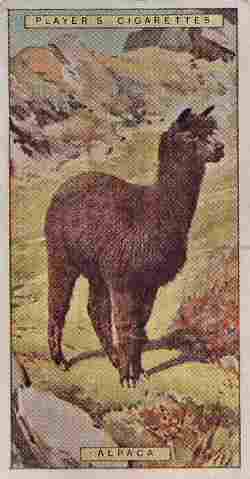
Alpaca, Players Cigarettes
A more obscure and rare alpaca and llama collectible can be found in the area of tobacco silks and Cartophily. Cartophily specifically defines the collection of cigarette cards though the modern definition has expanded to include the collection of other product trade cards. A cartophilic item is a specific card that is given away as a promotional or advertising aid. The cigarette cards usually have a specific theme such as animals, castles, famous people or trains. The front of the card pictures the subject matter while the reverse of the card carries additional advertising or in the case of a series, the title, card number and brief description of the picture. Other trade cards such as one for a specific brand of sewing machine often picture a scene on the front involving the product with more specific information on the back.
THE LLAMA, No. 17 of a series of 25 in a set entitled
“ANIMALS in the Service of Man” issued in London, England.
The idea of a trade card evolved out of the rough cards used by tradesmen in the late 1700’s to advertise their service. Though the precise origin of the trade card has been debated, they are thought to have originated in France around 1840 and had become popular throughout most European mainland countries by 1880.
During the Victorian era, it became a favorite pastime to collect these small, illustrated advertisements. Some examples from the early 1800’s still exist but not many were created until the spread of color lithography in the 1870’s. By the 1880’s, trade cards had become the major avenue for advertising America’s products and services.
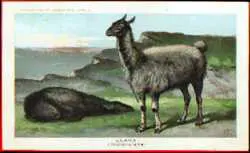
Llama Card, Arbuckels Coffee 1890 |
A more obscure and rare alpaca and llama collectible can be found in the area of tobacco silks and Cartophily. Cartophily specifically defines the collection of cigarette cards though the modern definition has expanded to include the collection of other product trade cards. A cartophilic item is a specific card that is given away as a promotional or advertising aid. The cigarette cards usually have a specific theme such as animals, castles, famous people or trains. The front of the card pictures the subject matter while the reverse of the card carries additional advertising or in the case of a series, the title, card number and brief description of the picture. Other trade cards such as one for a specific brand of sewing machine often picture a scene on the front involving the product with more specific information on the back.
This early cigarette trade card
(front and back shown) features the alpaca. It was manufactured in England by the Wills Co.
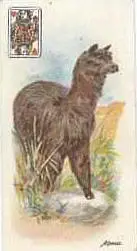
Cigarette cards enjoyed a significant but relatively short life. Highly competitive marketing during the Tobacco War of 1901-1902 led to a tremendous increase in the number of cards put into circulation. World War I brought heavy restrictions on the use of raw materials. This severely limited the production of cards. Cards of any possible subject matter that was feared could aggravate the conflict were destroyed. Daily life began to ease with the end of the war allowing cigarette trade card advertising to hit a new high over the next 20 years.
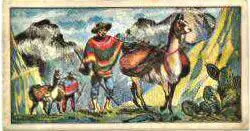
Llama Herd Card – Peru
It is, in fact, called the Golden Age of cigarette trade card manufacturing. A tremendous number of card sets were produced while Cartophilic clubs and shops sprang up in cities around the world in support of the collector. However, with the onset of World War II, the production of cigarette cards were again restricted or altogether banned. The UK wartime government officially banned their production as “a waste of vital raw materials.” With costs rising significantly in every sector of the economy, the cards were never fully revived after the end of the war. During this same time period, other forms of color advertising such as magazines had become a much more cost-effective medium. Some European countries continued to produce cigarette cards on a very limited basis through about 1940. Major cigarette card manufacturers ended their production in the United States around 1910. There were a few who continued to produce them with a near complete end to all production worldwide by 1940.
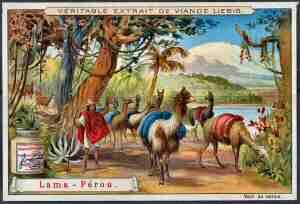
Today, there are very few manufacturers of any trade cards. Cards may still be occasionally found in a few products such as tea or chocolate. But, even the most popular and largest trade card manufacturer of “tea cards” ceased card production in 2000. The modern concept of trade card production has taken on a different focus becoming “trading” cards through the promotion of popular sports figures, movies or games. The collection of series trading cards such as Star Wars, Pokemon, baseball or Magic cards is a strong, vital business and it is not typical that one must purchase a particular product in order to acquire a card.
Tobacco silks? Just after the turn of the century, cigarette companies began to compete heavily and by about 1915, smoking was becoming commonplace for both men and women. Amidst this intense competition for customers, the effect of trade card advertising needed a boost. An additional competitive edge was needed. Some companies began to offer pictures on silk within their packaging to influence the buying power of women. It worked. Women were eager to obtain these small pictorial rectangles of silk. Soon cotton and silk were woven together allowing the opportunity for brighter colors. Companies would often go the extra length to include instructions for making household items from these “silks” — including quilts! Today, silks are usually much more valuable than the trade cards due to their more fragile nature.
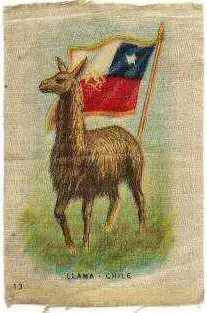
This silk pictures a llama with the Chilean flag in the background. It is part of a 1915 national flags and emblems series issued by the Imperial Tobacco Co. of Canada.
Today, Cartophily enjoys a strong following. There are specialized auctions, conventions, periodicals, catalogs and museums devoted to trade cards. While there does not appear to be hundreds of these trade cards that feature alpacas and/or llamas, it is amazing the number that do. Where might one find one? I smile to say that Ebay is an all but sure bet! A large number of web sites can be found by typing “trade card” or “cigarette card” into a search engine. The Cartophilic Society of Great Britain offers a reading list including both the British Trade Index and the World Trade Index and a bi-monthly magazine.