
Questions From Readers. Answers From Cathy
I receive numerous questions by phone and email each week. I do my best to answer as many as questions as possible but due to overwhelming numbers, I am truly unable to guarantee you will receive a timely response. While I do want to assist, it takes considerable time to respond to each and every email. Please consider making a donation when you receive a response for your questions.
I am also frequently asked to provide a more detailed consultation for the very complicated situation. Consultations are provided by phone and email. Like the Questions From Readers they are also supported by donations.
Q I just bought my first Llama — a 4-month-old female. My horses won’t have anything to do with her and are afraid of her. Will they ever herd together or will I always need to keep them separated? Should I buy another young female to keep her company? I would very much enjoy your newsletter. I also plan to order one of your halters. I know very, very little to nothing about llamas, except they are cute and sweet. I bought one also because I heard they keep coyotes off your property.
Thank You,
Colleen
A Hi Colleen, First and foremost, the little 4 month old you have is much too young to have been weaned and separated from her mother to be sold. For further information on weaning, please see my article on Weaning.
Additionally, she has not been allowed much opportunity in her short life to learn many ‘llama ways’ from her mother and the other herd members. She definitely needs a llama companion. Another female would be best and one that has been raised appropriately. As it is with most species, females interact and support other females differently than do a male and female. Finding a gelded male is certainly an option. It would be very important, however, that he is both fairly young and gelded or a little older gelded one who does not exhibit any breeding behavior. It is not impossible for a 6-month-old male to impregnate a 6-month-old female. At her exceptionally young age, without another llama companion she is very likely going to bond with you providing then an almost guarantee to go on to develop some serious and potentially dangerous behavioral problems as she matures. At best, she will not have any opportunity to learn about being a llama. Many are fully aware of those potentials in male babies but do not realize that under the right circumstances, females have the potential to become seriously dangerous as well.
Having this little baby girl in with horses is a bit dangerous for her. Most horses are not familiar with llamas and like yours, are afraid of them. Once used to them, they often become comfortable with llamas but there, unfortunately, still remains another problem — horses far out weigh even the largest llama. If there should ever be an occasion for dispute between a llama and a horse, the llama can suffer serious injury. Llamas will spit. Horses pack a powerful kick.
I, personally, find it quite disturbing that anyone who knows anything about llamas would have – in good conscious – sold you a single llama particularly at such a very young age. They owe you (and this little gal) the responsibility to teach you the basics of llama behavior and how to care for her. Perhaps that is unlikely, however, given they felt comfortable to be offering a 4 month old single llama in the first place. I highly recommend you contact your local llama association and make a serious effort to connect with some experienced llama owners in your local community for assistance. I know that my response is strong but I cannot impress upon you the clear potential of how very serious this situation might become in the future. There is little more devastating than to have developed a close and bonding relationship with this little gal and then have her suddenly become quite dangerous and unmanageable in a few more years. Unfortunately, you seem to have been handed most of the recipe for future heartbreak and disaster. The good news is that with the addition of another llama companion and the assistance of llama folks in your area, there is a very good possibility that things can work out well for all of you.
Regarding coyotes, llamas are not really guardians but rather sentinels. Guard llamas are typically the “first alert system” sounding the alarm and rounding up their charges. As a defender, however, they are prey animals themselves and do not have much power to truly defend against an actual attack. Additionally, not all llamas are well suited as a sentinel/guard. It is normally not so easy to judge the potential of whether one will or will not possess those traits until they are much older than she is.
If you would want to discuss your situation further, I am available for consultations. Please see my Consultations Page for more information.
My Best To You,
Cathy
Q
I have a question please. We have a two week old male cria that came out of his mom extremely FRIENDLY. He will bite our clothing and follow us around. He wants to come up to everyone and he will get very close and pull clothing and “talks” all the time. His mom and dad are both very laid back llamas. His mom has lots of milk as he weighed 21 at birth and at two weeks he weighs 35. He will bite on everything, wood, water bucket, pulls on the blankets we have in the barn. We have a 5 week old male cria and a one week old female cria. They all play. He is VERY active and jumps on his mom and the male cria all the time to play.
We don’t want to do the wrong thing with him. What advice do you have for us.
Thanks,
Judy
A Hi Judy, Regards your little male… unfortunately, these very friendly little ones — who are just born that way — can harbor the same potentials as one that has been inappropriately and/or over handled. While it is so tempting to engage him, the best thing to do is to minimize your interactions and set boundaries. Set the boundaries now for his behavior and invasion of your space just as you would for one that was inappropriately handled or who had necessarily needed to be extensively handled due to medical or some other reason. When he gets too close or nibbles on inappropriate things like your clothing, set boundaries. You may initially need to gain his attention by a little flick on the nose and a firm “stay back.” He should begin to understand and to respond appropriately in fairly short order. The key is to remain consistent. He cannot nibble on the clothing of one and be told to stay back by another. He is either allowed to nibble on clothing or he is not. As he becomes old enough, training will be a valuable lesson for him. Obstacle work would be helpful in providing him opportunities to listen, problem solve and gain confidence. These little guys may not be actually what we term as friendly but rather, very insecure. Interestingly enough, these personality types can often be more difficult to train. Why? Because they are not truly what we had viewed as easy and friendly but rather are confused, insecure and frightened. When he approaches people, is his tail up over his back? Is he humming? Is his head often lower to the ground or raised higher to look into your face? These behaviors likely indicate he is insecure and he is also asking questions — all manner of questions around where the boundaries are with you — with two legged’s. As a side note, notice a baby approaching his mother to nurse. Often the posturing and vocal will be quite similar. He is asking mom if he can nurse.
Wishing you the best, Cathy
Q I am having a hard time catching my llama. Nothing seems to work. How do you capture a skiddish llama?
Nicole, VT
A Hi Nicole, Without the benefit of a catch area, most llamas are not particularly easy to catch or “capture”. A catch area is a must. It can be constructed in a number of different ways with the optimum sizing no smaller than 9′ x 9′ and no larger than 12′ x 12′. It certainly does not have to be fancy but does need to be safe and secure. Corral panels, made specifically to interconnect and create a catch or holding area/pen, are available through a number of vendors and farm/feed stores. An existing stall can work well. Fence or gate panels can be fashioned together to create a catch pen. Creative configurations can be arranged using shed walls, fencing and gates. It is important that any catch area be a place where the llama can feel safe and comfortable. The ideal placement is to situate this catch area in or near their shelter and feeding spot. You need to be able to completely close it to contain the llama but it should be left open most of the time so that they can walk in and out of it freely. Treats can be offered in there and even placing their daily hay there at times will help them feel more motivated and comfortable to enter the area. If it is only used for “catching” they will quickly understand that concept and not go near it! It is useful if the catch pen itself could be situated within a larger catch area. An obvious example would be inside the barn. The animals can be herded into the barn, the barn doors closed and then the particular llama separated out and moved into the catch pen. No barn? A larger catch or containment area can be created with gates and fencing around the shelter/feeding area. The entrance/gate to this area would normally remain open, as they would obviously need access to shelter and feed. Coming and going into this larger area would be a very normal part of their routine.
My best to you, Cathy
Q Why do dams not lick their crias?
Marci, ID
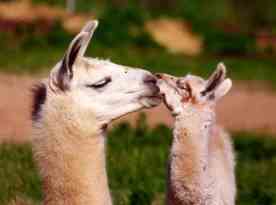
A While it seems licking a cria is not a very common practice of alpaca and llama mommas … or for alpacas and llamas in general, it does happen. Some mommas will lick their babies particularly in the first few days after birth. It is normally about the mouth though on occasion I have seen a mom lick her new baby on the little rear when the baby’s tail is up as it begins to search for milk. I actually have a great photo of a llama mom licking her baby about the face that I will include here. That would seem to be about the extent of it though. They certainly do not “clean” their young or eat/lick the birth membrane, as do some other animals.
With best regards, Cathy
Q I have just purchased my first 3 alpacas (intact males ages 1-3) and am studying training/handling methods. I have researched the TTeam method with Marty McGee Bennett and John Mallon’s methods. How does your method compare with these?
Tina
A
Hi Tina,
Thanks for taking the time to send me a note. There are a number of differences between the three of us as well as similarities. I am the only one who has chosen to attend the clinics of the others and I’ll do my best to explain the major points.
As you may know, we hosted the very first clinic Marty ever taught right here at our farm back in about 1988 or perhaps 1989? Marty and I then worked together for a number of years. I’ve also worked and co-taught with other camelid trainers. Around 1996, I studied for two years with Linda Tellington-Jones working with companion and other animals. My work with Linda was not connected with Marty. It happened during this time that I suddenly realized that in order to truly work with any animal of any species, one needed to have a good understanding of animal specific behaviors, both general to the species and specific to the particular animal — and directly connected/linked — how our own human interactions and responses influence. With that, it became clear for me that no method can work for every animal and every human in every circumstance every time. That brings us to probably the most significant difference between us. I do not teach nor lay claim to a specific method/best way of doing things… each has a place and time and, indeed, one or another “method” might be the most appropriate approach in a variety of situations. Rather, I teach creative and independent assessment in problem solving behavioral issues and training… understand the components and know why you have chosen a particular approach as well as why you might not feel to do something even though it has worked well in the past. Problem solving does not particularly include right and wrong answers but rather offers us a variety of possibilities to sort through for success in a specific instance.
As an example, I did private work with some folks with a very large alpaca herd. During the course of the day, we worked with 4 alpacas with serious leg issues. In assessing each animal, 2 of the 4 simply did not care to have their legs touched and most any of the specific methods offered out there for working with leg issues would likely be successful. The 3rd had had a serious leg injury. While it was long healed, he had an opinion. In this instance, it was important to consider possibilities or even create a possible way specific to his behavior and opinions. The 4th would have been a disaster creating additional problems had ANY method or approach been used. Without paying clear attention to this alpaca’s behavior and positioning and assessing/understanding what he was “saying” through his behavior, it would have been easy to miss — that for him, the kicking issues were about social crowding. He was moved to a larger area and the problem simply disappeared.
During my clinics, I do not myself normally work with even the most difficult animals — unless, of course, it is absolutely necessary. Folks want to be able to do what I do, not see that I can do it. A participant goes into the pen (and I smile to say, as a volunteer!) while the rest of the group supports them — everyone, altogether — interacting, assessing and problem solving each particular issue. It is a totally safe and supportive learning environment and by supportively interacting, assessing and problem solving as a group, everyone is involved and everyone tends to gain confidence that they CAN think through and handle a great deal more than they ever thought possible. They often find themselves relieved of the guilt they’ve carried that they are — or have been — doing something wrong, their animals don’t like them, they don’t know what they are doing, etc. It can be a pretty freeing experience and I have had a number of folks burst into tears at my clinics. Not in upset… but in a joyful relief in varying ways.
I do not use much equipment. It truly all depends… The absolute key is to understand positioning of yourself and the animal — to understand the unspoken between one another through body language/behavior. We spend most of the first morning of the first day really getting down into that. As a result, folks seem to truly understand what is then happening out in the pen, are able to immediately adjust and are almost instantly successful — even with difficult animals. With that understanding and success, my clinics move through a number of topics and difficulties amazingly quickly.
I believe each of us to be sincere in our approach to the training and care of alpacas and llamas. And I have a high regard for the many times we have each been able to assist folks and their animals. We have three distinctively different personalities and our training approaches vary from one another as well. I know it is important to know who we are and what we offer in order to do what fits best in your own personal world.
Probably MUCH more than you wanted to know! Again, thanks for asking and I hope this answers some of your wonderings.
With best regards,
Cathy
Q I’ve just discovered your web site but I haven’t found the answer to my specific problem. I bought an older llama as a guard animal for our small flock of sheep. She was a little wild but I thought it might just be because she had a cria, too. She’s done a great job of guarding the sheep. Basic health care with her is challenging because she is so wild. Catching her requires lots of help, a catch pen and is very traumatic for all of us. Giving her a CDT shot or trimming her nails is out of the question. She hasn’t been sheared ever. I would like to train her – or me – enough that we could perform necessary health checks without resorting to drugs. I’ve had lots of different advice. One said to halter her and tie her up and let her kick and struggle until she “got it out of her.” Another said that it is too late to do anything for her because she is too old. Well, we tried the first method but she struggled so hard that blood dripped from her lips. I let her go immediately and worried about her all day. Is there something else I should try?
Sincerely, Lorelei
A Hi Lorelei, Thank you for your email and I surely appreciate the concern you share around your older gal. It has strongly been my experience that alpacas and llamas really never become “too old” to learn something new. They are highly intelligent, sensitive beings and if physically healthy, older age rarely has much to do with their abilities to think, reason and communicate. Age can and does, however, bring with it a number of behavioral possibilities as their life experiences have caused them – as it does all of us – to form opinions, beliefs and notions about all manner of things. It would appear your older gal remains quite physically strong and has some definite opinions!
It has also been my experience that they rarely “get it out of” them unless we have, perhaps, “broken their spirit.” A specific behavioral problem is often replaced by another if the particular behavior has been thwarted without addressing possibilities of an underlying cause. It is not surprising your gal struggled so very hard. As with most animals, llamas must learn about being tied. It would seem in her case that she has not had any particular training nor particularly enjoys human contact. You also mention she has a cria from which she would have likely been separated. It is not unusual that a llama with the lack of training and trust she seems to exhibit might feel to struggle to the death rather than remain in that perceived compromising position. They are prey animals and it feels very dangerous to them to feel trapped. They can go into serious fear/panic mode injuring themselves. Some have actually broken their necks.
Being wild or untamed is one thing… in her case, there may be additional life experience reasons for her behavior. Time and consistency is key to any compromise or resolution. Your behavior – always – must remain consistent and therefore, predictable… becoming a trusted knowing for her over the long term. We cannot teach our alpacas and llamas how to trust. As in most all relationships (including human) it is not normally another’s responsibility to blindly trust but rather, our responsibility to be trustworthy. As prey animals, they are very skilled in their assessment of behaviors whether within their own species or not. They must know if that puma is just passing through or actually stalking. They observe and form what they feel might be life dependent opinions and decisions about us in the same way. That your gal was tied with such unpleasant results for all of you is not the end of any future possibilities, for sure… however…. In the overall context of things, that experience has been added into her life experiences and she has surely formed some opinions around it.
While I have never seen your older gal, I wonder if there is a true need for her to be shorn and her nails trimmed right now. An experienced llama owner in your area may be able to help you in that determination. If neither of those things is debilitating or life threatening, I would not do them for now. My most serious concern would be any specific health protocols for your area. If menengial worm exists where you are, then that would present a completely different circumstance – one that, in itself – can be life threatening and must be addressed. I would strongly suggest you contact the local llama association and connect with some experienced llama owners in your area.
Regards your specific question — “is there something else I should try?” – With the obvious caveat that I am not there and clearly have not seen your gal or your farm layout, it would seem that time and your own behavior are the two most important pieces for what may eventually make the significant difference for her. There should be a catch area or barn where she can begin to feel safe and comfortable in – where she is not particularly locked in to each time but is rather, free to come in and out as she feels to. Perhaps she can receive her hay there or offered a treat now and again. In my experience, trust and safety for her will come much more quickly if she is never again caught by a human grabbing her around the neck. As you might imagine, there is a good bit more to consider around ways you could move towards creating a much more peaceful and interacting relationship with this gal. While it is necessary that I receive compensation for spending involved time working with folks in problem solving behavioral issues, I felt strongly to offer you a bit of initial feedback.
Q
I am interested in the relative trainability of llamas as against alpacas? The latter always seem very highly-strung to my thinking, though I’ve had little to do with them.
Terry
A
I have been fortunate to have the opportunity to work with hundreds of llamas and alpacas across North America, Europe and New Zealand. Llamas and alpacas are different in a number of ways and yet they are very similar, too. It has been my ongoing experience that it is not so much about whether one is a llama or an alpaca but rather seems to have more to do with their individual personality and their personal history in interacting with humans. The intelligence level for both llamas and alpacas runs the same with some being very bright, some very slow and a whole lot in the average range. Understanding the overall general behaviors of llamas and alpacas before working with either of them is very important information that provides a good basis for how to proceed. One of the biggest differences
I’ve found between working with a llama or an alpaca is not so much about the animal but about our human approach. While an unruly grown alpaca can often be manhandled, it is quite another thing to take that approach with a full grown unruly llama. As a result, we are somewhat forced to take the time to learn how to otherwise handle llamas. Alpacas often do not receive that respect in approach causing them to react in fearful protest. Given they often appear naturally a bit more reactive, we then seem to label them as spitty, dumb and difficult. If a llama will not walk from his stall to the show ring, you simply don’t go. If an alpaca refuses to walk—and I have honestly personally seen this—no worries, just pick them up and drop them down at the entrance to the show ring. There are clearly differences in the overall personality between llamas and alpacas but that does not make alpacas dumb as rocks, just different. I have both llamas and alpacas here at my farm. While the majority have been quite reasonable to train, there has been the one llama or the one alpaca wherein their training seems to become an out of body experience. As a side note, I have judged a number of
4H events and worked with youth for many years. In the last few years I have been amazed to find that the participating alpacas have actually been more attentive, focused and skilled than most of the participating llamas. That is not to say alpacas are better than llamas, it is just an experience shared to illustrate that alpacas can be amazing animals, too.
I feel to say that comparing llamas and alpacas seems a bit unfair. Though both are in the camelid family, they are not the same animal. Seems perhaps a bit like comparing a mastiff to a border collie. Both are dogs with similarities and yet, there are differences in their behaviors and their “job” or “end use.” Respectful understanding of their unique personalities and behavioral traits can make the difference in whether or not we might consider one or the other difficult, dumb or truly amazing.
My best to you,
Cathy
Q
Do you recommend a good book or video on training llamas? Basics and packing? We just want to be sure we are going about it the right way.
Thank you, Beth and Mike, PA
A
Hi Beth and Mike,
There are a number of excellent books – both new and older ones — on care, training and packing. If you take a look at the publication offerings of the various vendors such as Quality Llama Products, Inc. or Useful Lama Items you will discover a vast number of alpaca and llama books, videos and CD-ROMS. Typing the name of a vendor or even “llama” or “alpaca books” into a search engine will bring up a number of sites. I believe there is truly something to be learned within all of them. Buying them all, however, can be fairly spendy! I would suggest contacting your local alpaca or llama association and becoming a member. Amidst the many benefits in belonging to and supporting your local association, most offer a library service to their members. These are great resource libraries containing many of the books, videos and CD-ROM’s relating to your particular interests. Most association libraries also include other publications on pasture management, behavior, poisonous plants, herbal remedies and more. Library materials are normally loaned out to members for just the cost of postage. Local association membership dues tend to run somewhere around $25 to $35 per year. Access to so many publications will also help you decide which books, videos or CD-ROM’s are important to you to purchase and include in your own personal camelid library.
My best to you and your llamas,
Cathy
Q
I read your article on weaning and I like the idea of letting “mother” do it – this makes the most sense. How do you handle taking the juveniles away to shows? Must they be weaned first so they aren’t crying and wondering where mother is throughout the whole show? I would appreciate your advice – I am puzzled as to what to do.
Julie
A
Hi Julie,
Thanks for your note. Honestly… I think it is much less stressful if you are planning to take an animal to a show that they be fully weaned first. As you know, show situations are much different than life at home on the farm! It would be much better not to add the additional stress of sudden weaning. It could be hard on the mom in varying ways as well.
Thanks for your question and I wish you the very best, Cathy
Q
After reading your articles on weaning I have decided to commit to allowing my llamas to wean their babies. I have 2 male crias, one 5 months and the other 1 month. I will geld the male who is now 1 month old, but would like to wait and show the 2nd male in April. My question is can I allow the older male to remain with the female herd [open moms and daughters] while his mother weans him? Or do I have to move both mom and son away from the main herd? This seems
drastic to me, but I do not want any of my llamas impregnated by this male either.
Thank you for any advice you can give me. I’ve collected all your articles and bound them–they are invaluable as I am a newbie llama owner.
Mary
A
Hi Mary,
Thanks for your note. While I, too, am committed to allowing my llamas and alpacas to wean their own babies, it is important to consider each situation specifically. Llama and alpaca boys are the difficult ones for natural weaning, as they will usually need to remain within the female herd. The specific dynamics and set up for each herd is different as is the individual make up of each animal. Each instance needs to be assessed individually.
I would feel that at 5 and 1 month, though perhaps possible, the chances of them impregnating a grown female right now is slight. By April, however, the older one will be a yearling. The chances begin to increase as each month passes. Much depends on the social, mental and physical attitude of the male. Some are not at all interested at a year while some are trying out their breeding skills by 6 months. You would have to evaluate his specific behavior and even then, you cannot be 100% sure that you have seen everything!
I believe it is important, if possible, that both the baby males have the opportunity to play and learn together. Rather than remove the older boy and his mom away from the main herd, is it possible to divide the herd in such a way that at the very least the two moms and their baby boys are together? Are there any females in the main herd that are already pregnant or can’t get pregnant? Perhaps you might be able to make a little larger separate group. I agree that isolating a single mom and her baby feels drastic and hopefully, there might be another alternative. Isolation would seem to place a great deal of hardship on that mom. I understand that there are open females and daughters but maybe you can create a separate little herd with at least those two moms and their babies. I believe that would allow for overall better emotional health for all concerned — you, included! As time goes on, you will need to be mindful of the male activity even in that small separate group. It is possible that they might breed the moms if the moms remain open. An additional consideration with natural weaning is the experience of the mom. On occasion, first time moms and even older moms who have never had the opportunity to self wean their own babies are not sure of the process. They will sometimes allow the baby to nurse for years!
I am sorry that I cannot be absolute in answering your query. That’s the thing about behavior! There are many variables to consider overall as well as things specific to any one herd group and/or individual animal. I encourage you to use your intuitions and best judgment on how to proceed. It will serve you well.
Wishing you the best,
Cathy



Whether you’re taking your first steps into camelid ownership or you’re an experienced handler seeking new insights, Gentle Spirit Llamas is here to support your journey.